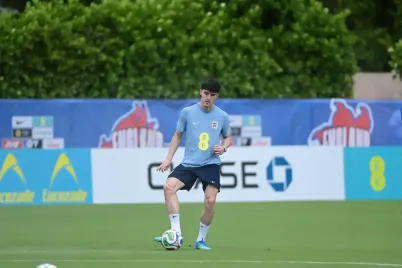

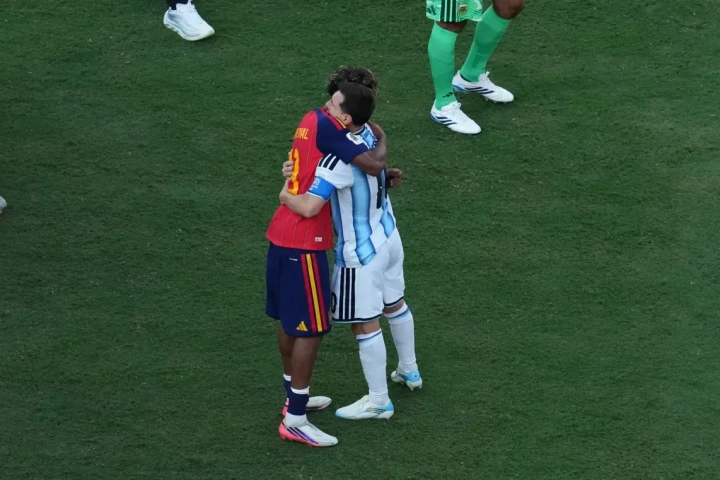
As the confetti rained down upon the freshly laid turf of the New York New Jersey Stadium on Sunday evening, the global television feed lingered on two distinct, contrasting images that will forever define the 2026 FIFA World Cup. In one corner of the pitch, Lamine Yamal, Spain’s effervescent 19-year-old sensation, danced wildly with the golden trophy, draped in the red and yellow of his nation. In another, Lionel Messi, the architect of a generation and the heartbeat of Argentina, trudged slowly towards the tunnel, his gaze fixed firmly on the grass.
In a gruelling, historic final that stretched to 120 minutes of sheer physical and tactical attrition, Spain emerged as 1-0 victors, capturing their second star and completing a spectacular era of dominance. A 106th-minute strike from substitute Ferran Torres ultimately separated the two sides, breaking an Argentine resistance that had been heroically anchored by goalkeeper Emiliano Martínez and fatally compromised by a red card to Enzo Fernández deep into stoppage time.
But beyond the statistics, the medals, and the tactical mastery deployed by Spanish head coach Luis de la Fuente, this match represented something far more profound. It was the definitive, undeniable passing of the torch from one footballing epoch to the next.
The Boy King Assumes the Throne
When the tournament began across North America five weeks ago, the narrative surrounding Lamine Yamal was one of immense potential. Having celebrated his 19th birthday just days before the final, the Barcelona winger had already carried an unfathomable burden of expectation. Yet, under the blinding lights of the 80,663-capacity MetLife Stadium, Yamal did not simply participate in the grandest fixture in global sports, he dictated it.
Yamal was the undisputed conductor of La Roja’s attack. Faced with the notoriously combative Argentine defensive block, he exhibited a level of maturity and technical audacity that belied his teenage years. He isolated defenders, dropped his shoulder, and continuously carved open pockets of space that simply should not have existed. In the first half, his curling effort drew a sensational, sprawling save from Martínez. In extra time, following Fernández’s dismissal, Yamal had another golden opportunity from a 22-yard free-kick, forcing Martínez into yet another desperate intervention to keep Argentina’s flickering hopes alive.
His performance in the final was merely the crescendo of a historic campaign. While the Golden Ball for the Player of the Tournament rightly went to his compatriot Rodrigo Hernández, the metronomic anchor of the Spanish midfield, Yamal’s sheer electricity captured the world’s imagination. He represents a new breed of Spanish footballer: technically flawless, yet possessing a direct, ruthless verticality that the famed tiki-taka sides of the past occasionally lacked.
The Last Dance Denied
For Argentina, the overarching narrative of the 2026 World Cup was always going to revolve around Lionel Messi’s quest for back-to-back global crowns. At 39 years old, operating with heavily conserved energy reserves and relying entirely on his unparalleled footballing intellect, Messi dragged Lionel Scaloni’s side to the final through sheer force of will.
However, against Spain, the fairy tale met a harsh, impenetrable reality. De la Fuente’s tactical blueprint was executed with surgical precision. Spain completely suffocated the Argentine midfield, severing the supply lines to both Messi and Julián Álvarez. The statistics from regulation time paint a startling picture of dominance: Spain took 15 shots to Argentina’s zero, dominating the corner count nine to one. Throughout the entirety of the 120 minutes, Argentina mustered a mere two attempts, neither of which found the target.
Messi spent vast swaths of the evening isolated, forced to drop deeper and deeper into his own half just to feel the leather of the ball. When he did gain possession, he was instantly swarmed by a coordinated Spanish press, spearheaded by Pau Cubarsí, who rightfully claimed the tournament’s Young Player Award, and Aymeric Laporte.
As the final whistle blew, there were no tears from the Argentine captain, only a solemn acceptance. Messi has given everything to the Albiceleste, culminating in the joyous triumph in Qatar four years prior and the recent 2024 Copa América title. But time, the ultimate undefeated opponent, had finally caught up with the reigning world champions. The heartbreak in New Jersey was not born of a lack of effort, but of a physical and tactical exhaustion against a Spanish machine that was simply too vibrant, too relentless, and too young.
A Tactical Gridlock and the Turning Point
To understand how the match was ultimately won, one must examine the gruelling, attritional nature of the midfield battle. For 90 minutes, Argentina defended with the desperation of a team fully aware that they were being outplayed. Their survival rested almost entirely on the broad shoulders of Emiliano Martínez. The Aston Villa goalkeeper delivered arguably the greatest individual goalkeeping performance in a World Cup final, producing a staggering 12 saves to continually deny Yamal, Marc Cucurella, and Nico Williams.
But the dam inevitably began to crack in the third minute of second-half stoppage time. Chelsea midfielder Enzo Fernández, who had been booked earlier in the half, launched into a reckless, desperate challenge on the advancing Cubarsí. The referee did not hesitate, producing a second yellow card and reducing Argentina to ten men just moments before the onset of extra time.
It was a fatal blow to Scaloni’s meticulously crafted survival strategy. Entering extra time a man down against the most possession-dominant side in international football is akin to a slow sporting execution. Spain stretched the pitch, utilising the wide channels and forcing the exhausted Argentine defenders to chase shadows.
The Culmination: Torres Strikes Gold
The decisive moment arrived in the 106th minute, the very first sequence of the second period of extra time. Luis de la Fuente’s substitutions proved to be the ultimate masterstroke. Ferran Torres, who had replaced Mikel Oyarzabal in the 62nd minute, provided the fresh legs and attacking instinct required to finally breach Martínez’s defences.
As a loose ball bounced erratically inside the Argentine penalty area, Torres reacted with predatory speed. He pounced on the momentary hesitation from the fatigued Argentine centre-backs, driving a fierce, left-footed strike just beneath the crossbar. The net bulged, and the deafening roar of the Spanish contingent echoed across the Hudson River.
“It was a goal scored by 47 million people,” an emotional Torres stated in the mixed zone following the victory, perfectly encapsulating the collective relief and jubilation of a nation that had waited 16 years to reclaim the world title.
A New Era Dawns in Global Football
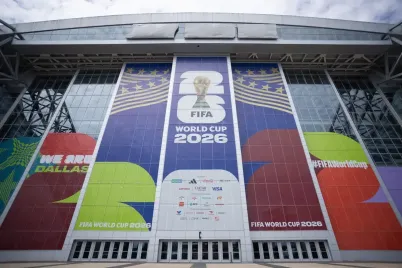
As the Spanish squad paraded the trophy, adding a second star to their crest and simultaneously holding both the men’s and women’s World Cup titles, the broader implications of the evening became clear. The 2026 World Cup was supposed to be the grand North American celebration, the largest tournament in history featuring 48 teams. It delivered on its promise of spectacle, drawing a star-studded crowd in New York that included global music icons, Hollywood royalty, and heads of state.
Yet, stripped of the celebrity glamour and the closing ceremony pyrotechnics, what transpired on the pitch was a pure, unadulterated changing of the guard. Unai Simón’s Golden Glove and Rodri’s Player of the Tournament award highlighted a team that is entirely complete from back to front.
Argentina will return to Buenos Aires as fallen champions, facing the daunting task of rebuilding a squad without the talismanic figure who has defined their footballing identity for nearly two decades. The post-Messi era has officially arrived, bringing with it a profound sense of melancholy for football purists around the globe.
Spain, conversely, looks toward the 2030 World Cup, which they will co-host, with a squad that is terrifyingly young, exceptionally gifted, and now heavily decorated. Lamine Yamal has taken the torch, holding it aloft for a new generation. If his performance in New Jersey is any indication, the future of the beautiful game is in spectacularly safe hands.