
The confetti has barely been swept from the concourses of the New York New Jersey Stadium, yet the global post-mortem of the 2026 FIFA World Cup Final is already in full swing. Spain’s historic 1-0 extra-time victory over Argentina on Sunday evening confirmed La Roja’s return to the absolute pinnacle of international football, securing a second star for their crest. Substitute Ferran Torres delivered the decisive 106th-minute dagger to break the reigning champions’ resistance, culminating a gruelling 120-minute battle of tactical attrition. However, for observers watching from British shores, the grandest fixture in the global sporting calendar felt remarkably familiar.
While the flags waving in the East Rutherford stands were predominantly red, yellow, and sky blue, the match itself was heavily dictated by the stars of the English Premier League. From the midfield orchestration that suffocated Lionel Messi, to the heroic goalkeeping that kept the South Americans alive, right down to the catastrophic moment of indiscipline that ultimately decided the tie, the Premier League contingent left an indelible, defining mark on the final. Here is the comprehensive breakdown of the domestic heroes and villains who shaped the climax of the 2026 World Cup.
The Hero: Rodri’s Golden Coronation
If there was any lingering debate regarding the identity of the finest defensive midfielder of his generation, Sunday evening decisively ended the conversation. Manchester City’s Rodri was the undisputed metronome of Luis de la Fuente’s Spanish machine. In a match where the stakes could not have been higher, the 30-year-old delivered a masterclass in spatial awareness, tempo dictation, and relentless ball recovery.
Spain’s tactical blueprint relied entirely on starving Argentina of possession, a strategy executed to such perfection that the reigning champions became the first team in modern history to go a full 90 minutes of a World Cup final without registering a single shot on target. At the heart of this suffocating dominance was Rodri. He completed a staggering 101 passes in the final alone, constantly recycling the ball and shielding a youthful defensive line composed of Pau Cubarsí and Aymeric Laporte.
When Rodri was eventually substituted in the 98th minute for Arsenal’s Martín Zubimendi, he departed the pitch having thoroughly exhausted the Argentine midfield. His monumental efforts across the five-week tournament were rightfully recognised during the trophy presentation when he was awarded the Golden Ball as the Player of the Tournament. For a player who has already claimed five Premier League titles, the Champions League, and the European Championship, adding the World Cup and the Golden Ball officially secures his status within the pantheon of footballing immortals.
The Villain: Enzo Fernández’s Catastrophic Dismissal
In stark contrast to Rodri’s measured brilliance, Chelsea’s Enzo Fernández endured a night that will haunt him for the remainder of his career. Arriving in North America as a defending champion and a vital cog in Lionel Scaloni’s midfield engine, the 25-year-old was tasked with disrupting the Spanish rhythm. Instead, he became the architect of his own nation’s demise.
The match had always threatened to boil over into a deeply physical, hostile encounter. Fernández, tasked with tracking the elusive movements of Dani Olmo and Pedri, spent the majority of the evening chasing shadows. The frustration manifested in the 82nd minute when he was shown his first yellow card for a late, cynical challenge. Given the immense pressure Spain was exerting, the fundamental rule of survival for Argentina was to maintain their numerical parity.
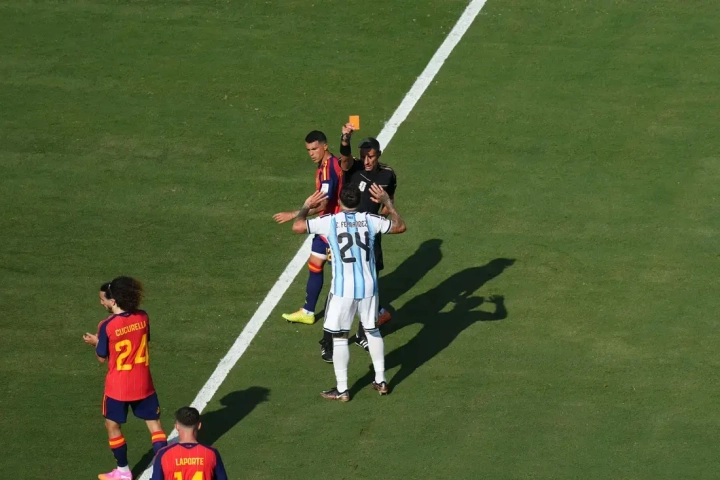
Yet, in the second minute of second-half stoppage time, with the scoreboard locked at 0-0 and extra time looming, Fernández committed a fatal error of judgment. Launching into a reckless, entirely unnecessary challenge on the advancing Cubarsí, he left the referee with absolutely no alternative. The second yellow card was swiftly followed by the red, and Fernández was sent on a lonely march down the MetLife Stadium tunnel.
Going down to ten men against the most possession-dominant side in international football is essentially a slow sporting execution. Fernández’s dismissal completely shattered Argentina’s hopes of surviving the additional thirty minutes. Stripped of their midfield enforcer, the South Americans were forced into a desperate, deep-lying rearguard action that Spain inevitably breached. For Chelsea fans watching back home, the chaotic indiscipline mirrored the inconsistencies that have occasionally plagued his domestic career at Stamford Bridge.
The Defiant Wall: Emiliano Martínez
While Fernández undoubtedly assumes the mantle of the final’s primary villain, his compatriot Emiliano Martínez delivered a heroic performance of legendary proportions. The Aston Villa goalkeeper was the sole reason Argentina survived the initial 90 minutes of regulation time. As Spain mounted wave after wave of intricate, overwhelming attacks, Martínez stood as an impenetrable, defiant wall.
The statistics from the evening are nothing short of astonishing. Martínez registered a breathtaking 12 saves throughout the match, repeatedly denying the likes of Lamine Yamal, Nico Williams, and Fabián Ruiz. His sprawling, fingertip save to deny Yamal’s curling free-kick in the second half will be replayed in highlight reels for decades to come.
Martínez commanded his penalty area with his trademark bravado, absorbing immense physical pressure from the Spanish forwards while constantly organising a besieged, heavily patched-up defensive line. Even in defeat, the 33-year-old reaffirmed his status as arguably the finest big-game goalkeeper in world football. He did everything humanly possible to drag his nation to a penalty shootout, only to be undone by a close-range strike that no goalkeeper could have prevented.
Tottenham’s Triumph and the Supporting Cast
Beyond the headline acts, the supporting cast of the final was heavily populated by Premier League regulars. Tottenham Hotspur notably provided crucial personnel for both sides. For the victors, Pedro Porro started at right-back, selected ahead of Marcos Llorente. The Spurs defender fully justified his inclusion, combining defensive solidity with relentless attacking overlaps. It was Porro who delivered the deep, searching cross that Nico Williams brilliantly headed down for Ferran Torres to smash home the 106th-minute winner.
On the opposing flank, Porro’s club teammate Cristian Romero fought valiantly at the heart of the Argentine defence. Romero was forced to assume immense leadership responsibilities after Manchester United’s Lisandro Martínez was forced off the pitch in the first half following a tactical foul and a subsequent injury.
In the midfield trenches, Liverpool’s Alexis Mac Allister toiled tirelessly for the South Americans. Much like Julián Álvarez up front, Mac Allister was utterly starved of possession, spending his evening engaged in a gruelling, thankless defensive shift before the numerical disadvantage finally took its toll.
The Post-Match Chaos: Tempers Flare
The sheer hostility of the encounter was not confined to the 120 minutes of match action. The explosive, fiercely competitive nature of the fixture spilled over immediately following the final whistle. The heartbreak and exhaustion of the Argentine squad, compounded by the perceived injustice of Fernández’s red card, ignited chaotic scenes on the pitch.
The flashpoint was sparked by Boca Juniors’ Leandro Paredes, who violently shoved Spain’s Gavi and Eric García as the Spanish substitutes flooded the pitch to celebrate. The confrontation rapidly escalated, requiring security personnel and coaching staff, including a visibly irate Lionel Scaloni, to separate the warring factions. It was a bitter, ugly conclusion to an otherwise enthralling tactical battle, highlighting the immense, crushing pressure that the World Cup final exerts on those brave enough to step onto the pitch.
Conclusion
As the triumphant Spanish squad embarks on a flight back to Madrid to parade the iconic golden trophy, the Premier League contingent will soon board their respective flights back to the United Kingdom. In a matter of weeks, the international rivals will once again become domestic teammates, trading the international stage for the relentless grind of the English top flight.
Yet, the narratives forged under the lights of New Jersey will inevitably linger. Rodri will return to Manchester City as a freshly crowned global king and the undisputed master of his craft. Emiliano Martínez will return to Villa Park with his head held high, having delivered a performance for the ages. Meanwhile, Enzo Fernández will report back to Chelsea’s Cobham training ground bearing the heavy, inescapable weight of the mistake that ultimately cost his country the world.