
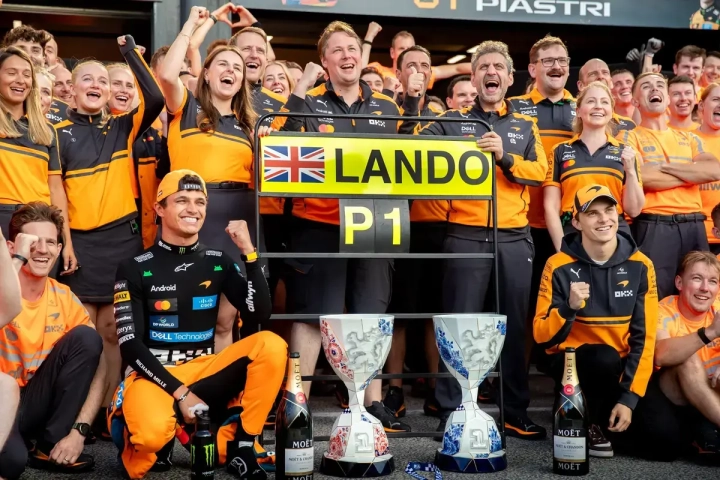
In a race defined by early chaos, strategic gambles, and a breathtaking display of tyre management, McLaren’s Lando Norris delivered a defining statement of intent by winning the 2026 Formula 1 Dutch Grand Prix. Overhauling championship leader Kimi Antonelli in the closing stages, the defending world champion claimed back-to-back victories to breathe renewed life into his title defence. However, the thrilling tactical battle at the front was entirely overshadowed during the opening exchanges by a monumental crash involving home hero Max Verstappen, bringing a sudden and shocking end to the Red Bull driver’s afternoon.
As Formula 1 descended upon the challenging, undulating coastal dunes of the Circuit Zandvoort, for what could potentially be the final Dutch Grand Prix on the sport’s calendar, the atmosphere was predictably electric. The grandstands, blanketed in their customary sea of orange, had gathered in expectation of seeing their national icon challenge the front-runners. Instead, they were left in stunned silence before the opening lap was even completed.
First-Lap Chaos and Home Heartbreak
Starting from pole position after edging out George Russell and Antonelli in a tense qualifying session on Saturday, Norris executed a solid initial launch. The damp, slippery surface, however, immediately proved treacherous.
Navigating the sweeping final corner of the opening lap, Verstappen lost control of his Red Bull machinery, spinning wildly before suffering a heavy, high-speed impact with the outer barriers. The collision shattered the car and scattered carbon fibre debris across the racing line. The magnitude of the crash immediately prompted race control to deploy the red flags, initiating a 40-minute stoppage to allow for extensive barrier repairs.
Crucially, Verstappen emerged from the wreckage entirely unhurt, but the premature exit delivered a devastating blow to the Dutch faithful. The lengthy delay was further compounded by early drama for Haas, as Ollie Bearman was forced to retire his car before the restart with a suspected power unit failure on the formation lap.
The Restart and Antonelli’s Audacious Move
When the track was finally cleared and the race resumed via a standing start, it was Mercedes’ prodigious Italian talent, Kimi Antonelli, who seized the initiative. Demonstrating the supreme confidence that has propelled him to the summit of the drivers’ standings this season, Antonelli surged past Norris into Turn 1, wresting the lead away from the McLaren driver.
For a substantial portion of the afternoon, Antonelli looked in imperious control. The Mercedes appeared exceptionally well-balanced around Zandvoort’s banked corners, allowing the Italian to establish a commanding rhythm at the front of the pack. Norris, rather than panicking, opted to bide his time, meticulously managing his tyres and ensuring he remained within striking distance of the championship leader.
The strategic divergence became apparent during the first sequence of pit stops. Mercedes called Antonelli into the pits on lap 40, aiming to cover any potential undercut. McLaren, however, rolled the dice, committing Norris to a remarkably long opening stint. The British driver extended his run for a further seven laps, eventually pitting on lap 47. It was a gamble that would ultimately dictate the outcome of the race.
Norris Strikes Back
Rejoining the circuit with a significant tyre offset, Norris possessed a distinct grip advantage. He rapidly closed the gap to the Mercedes, setting a sequence of fastest laps that placed him firmly in Antonelli’s gearbox.
The decisive moment arrived on lap 54. Utilising the superior traction of his fresher rubber, Norris launched a brilliant, daring overtake around the outside of Turn 1. The move was perfectly executed, leaving Antonelli with no room to counter. “I knew I wouldn’t get many chances,” Norris later reflected on the team radio. “I probably had one chance to make it happen, and that move won me the race.”
Virtual Safety Cars and Tactical Friction
What initially appeared to be a straightforward cruise to the chequered flag for McLaren was abruptly thrown into jeopardy on lap 56. Esteban Ocon’s Haas suffered a mechanical failure, grinding to a halt at Turn 3 and triggering a Virtual Safety Car (VSC).
The VSC presented a crucial strategic window, prompting a flurry of activity in the pit lane. Mercedes seized the opportunity, boxing Antonelli for a fresh set of soft tyres. Ferrari mirrored the tactic with both Lewis Hamilton and Charles Leclerc. Intriguingly, Norris and George Russell remained on track, inheriting the top two positions but leaving themselves highly vulnerable to the chasing pack on superior rubber.
When the VSC period concluded, Mercedes found themselves facing an internal conundrum. Armed with significantly faster tyres, Antonelli rapidly closed up to the back of his teammate. On lap 65, the Mercedes pit wall intervened, instructing Russell to move aside and allow Antonelli to hunt down Norris. The decision incensed Russell, who vehemently argued over the team radio that they had “lost a double podium” by forcing him to surrender track position.
Late Drama and the Final Standings
Despite Antonelli’s late charge, Norris’s advantage proved insurmountable. The McLaren driver managed his ageing tyres with exquisite precision, ultimately crossing the line 11.536 seconds ahead of his Italian rival.
Behind the leading duo, Russell was left desperately fending off a charging Lewis Hamilton. The seven-time world champion, now adorned in Ferrari red, was visibly frustrated by his own team’s strategic decisions earlier in the race, having fruitlessly requested a position swap with teammate Charles Leclerc. A late full Safety Car, caused by a bizarre collision between the Williams teammates Carlos Sainz and Alex Albon, offered Hamilton a final opportunity, but Russell clung on to secure third place by a marginal 0.849 seconds.
Leclerc finished a lonely fifth for the Scuderia, while McLaren’s Oscar Piastri crossed the line in sixth. Red Bull’s Liam Lawson salvaged some pride for the Milton Keynes outfit by securing seventh place, following Verstappen’s early exit. Nico Hülkenberg delivered a commendable drive for Audi to finish eighth, with Fernando Alonso (Aston Martin) and Pierre Gasly (Alpine) completing the top ten points-paying positions.
The victory ensures McLaren claim their third consecutive triumph at Zandvoort, but the championship landscape remains firmly in Mercedes’ favour. Despite settling for second, Antonelli extended his lead at the top of the Drivers’ Championship to 242 points. Russell and Hamilton now share second place with 183 points apiece, whilst Norris’s back-to-back victories propel him to 159 points, keeping his faint title hopes alive as the European leg of the season draws to a close.
2026 Dutch Grand Prix – Race Results (Top 10)
| Position | Driver | Team | Gap / Time | Points |
| 1 | Lando Norris | McLaren | 2:04:44.859 | 25 |
| 2 | Kimi Antonelli | Mercedes | +11.536s | 18 |
| 3 | George Russell | Mercedes | +15.906s | 15 |
| 4 | Lewis Hamilton | Ferrari | +16.755s | 12 |
| 5 | Charles Leclerc | Ferrari | +17.258s | 10 |
| 6 | Oscar Piastri | McLaren | +32.332s | 8 |
| 7 | Liam Lawson | Red Bull Racing | +1:19.915s | 6 |
| 8 | Nico Hülkenberg | Audi | +1 Lap | 4 |
| 9 | Fernando Alonso | Aston Martin | +1 Lap | 2 |
| 10 | Pierre Gasly | Alpine | +1 Lap | 1 |
2026 Drivers’ Championship Standings (Top 5)
| Position | Driver | Team | Points |
| 1 | Kimi Antonelli | Mercedes | 242 |
| 2 | George Russell | Mercedes | 183 |
| 3 | Lewis Hamilton | Ferrari | 183 |
| 4 | Lando Norris | McLaren | 159 |
| 5 | Charles Leclerc | Ferrari | 155 |