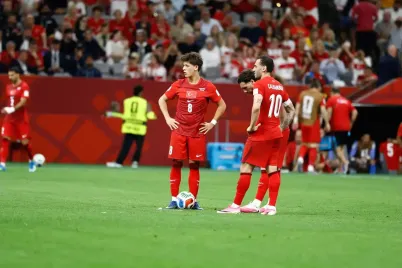


Wales travel to Copenhagen on Sunday seeking their first points of the new UEFA Nations League campaign, with Craig Bellamy’s side facing Denmark at Parken three days after a narrow defeat in Portugal. Both teams lost their League A Group A4 openers, giving this meeting an immediate importance that goes beyond the early stage of the competition. For Wales, it is a chance to build on a determined performance in Lisbon while finding more of the attacking threat needed to take something from another difficult away fixture.
Kick-off is at 5pm UK time, and the short turnaround leaves little room for either manager to dwell on Thursday’s result. Wales fell 1-0 to the defending Nations League champions after João Félix’s first-half shot took a deflection off Ben Davies. Denmark’s opening match was considerably more open: Brian Riemer’s team lost 3-2 in Norway, recovering from an early two-goal deficit to draw level before Erling Haaland struck the winner. Neither side has a point, but their contrasting first games offer an intriguing starting point for Sunday’s contest.
Bellamy could take encouragement from the way Wales stayed in the match against Portugal despite long spells without the ball. Danny Ward made saves as the hosts created chances, while Cristiano Ronaldo missed a clear opportunity and later had a goal ruled out for offside. Brennan Johnson came closest to an equaliser when he hit the crossbar from a tight angle in the second half. Lewis Koumas, rewarded with a start after an impressive opening to his club season, also gave Wales an outlet and helped them make a positive beginning before Portugal took control.
The scoreline, however, cannot disguise the need to create more. Wales defended with resolve but had limited possession in dangerous areas, and opportunities to break forward became more frequent only as the second half progressed. Johnson’s pace unsettled Portugal at times, and the introduction of Dan James added another direct runner. Against Denmark, Bellamy will want those moments to arrive more regularly. Reaching an advanced position is only part of the task; Wales must also give their forwards enough support to make promising transitions count.
That challenge has been complicated by the absence of Harry Wilson. The Leeds United attacker withdrew from the squad with a quadriceps injury after missing his club’s recent draw with Crystal Palace. His ability to carry the ball, combine in tight spaces and provide a threat from distance would have been valuable in two away games against strong opposition. Wales are also without Nathan Broadhead, who pulled out with a thigh problem, and goalkeeper Karl Darlow. Joe Rodon’s hamstring injury had already removed an established defender from Bellamy’s options before the squad assembled.
Those absences have changed the shape of the group Bellamy originally selected. Ward started in goal against Portugal, while captain Davies and the defenders around him had to withstand sustained pressure. Ben Cabango, Chris Mepham, Rhys Norrington-Davies and Jay DaSilva are among the defensive options available for the Copenhagen fixture. Bellamy has choices, but any adjustment must account for Denmark’s movement across the front line as well as the need to keep Wales capable of advancing quickly when possession changes hands.
The midfield will have an equally demanding evening. Ethan Ampadu offers leadership and composure, while Jordan James returned to the national squad for this window after missing the June friendlies. Josh Sheehan and Joel Colwill provide different options should Bellamy alter the balance or need fresh legs. Denmark are likely to make central areas difficult to navigate, and Wales will need to resist the temptation to send every regained ball forward immediately. At times, keeping possession for a few passes may be the best way to relieve pressure and bring their wide players into the game.
Bellamy also has newcomers and returning players to consider across a sequence of four matches in less than two weeks. Cardiff City’s Cian Ashford received his first senior call-up in the original squad, recognition of his progress at club level. Joe Taylor and goalkeeper David Cornell were subsequently called up following the withdrawals, while Charlie Savage returned to the senior group. A call-up does not guarantee minutes against Denmark, particularly after such a demanding opening fixture, but the extended window gives Bellamy opportunities to assess players who may have a larger part to play as it develops.
Wes Burns offers another option after returning to the Wales squad following a serious knee injury. His presence, alongside Johnson, James, Koumas, David Brooks and Sorba Thomas, gives Bellamy several possible combinations in the wide and attacking positions. Kieffer Moore provides a different route forward if Wales need a target higher up the pitch, while Mark Harris and Liam Cullen add further choices. The decision is about more than selecting the quickest players. Whoever starts must help Wales move up the field together so that an isolated break does not end with the ball coming straight back.
Denmark will have their own reasons to seek a sharper collective performance. Norway scored twice in the opening 18 minutes on Thursday, through Oscar Bobb and Haaland. Mikkel Damsgaard reduced the deficit before the break and Rasmus Højlund equalised after an hour, only for Haaland to restore the hosts’ lead. The response demonstrated Denmark’s attacking quality and their ability to recover from a poor start. Conceding three, though, will concern Riemer before a home match in which his team will expect to spend more time on the front foot.
Højlund’s goal in Oslo underlined the danger he poses near goal, and Wales cannot afford to focus on him alone. Damsgaard’s movement and creativity can open space around a defence, while Patrick Dorgu and Gustav Isaksen offer pace in wider areas. Pierre-Emile Højbjerg captained Denmark against Norway, with Morten Hjulmand and Victor Froholdt also starting in midfield. Joachim Andersen was part of the defence. Riemer has established internationals to call upon, although Thursday’s defeat may prompt him to reconsider how much protection his side gives its back line when it attacks.
There are fresh faces in the Danish squad, too. Thomas Jørgensen, Mads Bidstrup, Viktor Bak and goalkeeper Andreas Jungdal were named among players who could make senior debuts during this international window. Bidstrup and Jørgensen came off the bench in Norway, adding to Riemer’s choices ahead of Sunday. The manager must weigh the benefit of continuity against the physical demands of playing again so soon after a match in which Denmark chased the game for much of the evening.
Wales know this opponent from significant meetings in recent years, though those results cannot decide a game involving different squads and managers. Denmark won both fixtures between the nations in the 2018 Nations League and knocked Wales out in the last 16 of Euro 2020. Sunday brings a new contest and, unusually, the first of two meetings within eight days. Denmark will visit Cardiff on 4 October, after Wales host Norway and the Danes face Portugal. What either side learns at Parken could therefore matter again almost immediately.
The broader group picture adds weight to an early result. Wales returned to League A after winning their previous Nations League group unbeaten under Bellamy, earning three victories and three draws in 2024. This level presents a harder examination. The top two teams in Group A4 advance to the quarter-finals; third place leads to a relegation play-off, while the bottom side is relegated. One defeat does not determine a campaign, but taking points before the two home fixtures would give Wales a firmer platform after a demanding start on the road.
Recent results also need to be viewed in context. Wales missed the summer’s World Cup after losing a March play-off to Bosnia and Herzegovina on penalties. June then brought friendly matches intended to help the squad move forward, including a victory in Romania, before Thursday’s return to competitive action against Portugal. Bellamy’s team could reasonably feel encouraged by remaining within one goal of the holders in Lisbon. Encouragement alone will carry less value, however, unless they can turn it into points during this international window.
Much may depend on the opening exchanges in Copenhagen. Denmark’s experience in Oslo gives Wales a clear reason to test their defence early, but the home side’s comeback also shows the risk of assuming an early advantage would settle anything. Bellamy will want his players organised when Denmark have the ball and alert to the spaces available when they regain it. A sustained Welsh spell in possession, a well-timed run behind the defence or a carefully delivered set piece could change a match in which clear chances may be hard earned.
For Davies, Ampadu and the more experienced members of the squad, the task is to help Wales repeat the discipline they showed in Lisbon without allowing the evening to become another prolonged defensive exercise. For Koumas and the other younger players, it is an opportunity to show they can contribute at League A level against another established European side. The balance between those demands will shape Bellamy’s selection and his substitutions as the game unfolds.
Denmark and Wales arrive at Parken disappointed but far from out of contention. The hosts will draw confidence from scoring twice in Norway; the visitors can point to the fight that kept them close to Portugal until the final whistle. Sunday offers each side a chance to give those positives substance. If Wales can retain their defensive resolve and supply their attackers more consistently, they have an opportunity to leave Copenhagen with a result that changes the feel of their Nations League campaign.